Grand Oaks Tree Service provides emergency tree removal in Brandon, FL, for fallen, split, leaning, uprooted, and storm-damaged trees. If a tree is threatening your property or blocking essential access, call (813) 670-9930 to explain the situation and request service.
Tree damage can leave heavy branches suspended above a roof, driveway, vehicle, or frequently used area. A tree may also remain standing after its trunk has split or its roots have shifted. These conditions require a careful assessment because a damaged tree can continue moving after the weather has cleared.
Our team evaluates the tree, surrounding structures, available access, and equipment needs before planning the removal. We then explain the proposed work and provide an estimate based on the specific conditions at your property.
What Counts as a Tree Emergency?
A tree emergency is a situation where damaged or unstable tree material presents an immediate concern for people, structures, vehicles, or essential access. The tree does not have to be completely on the ground to require urgent attention.
Some emergencies are obvious, such as a tree that has fallen onto a home or across a driveway. Others involve partially failed trees that remain upright. A hanging branch, split trunk, or lifted root plate may be difficult to evaluate from the ground.
Our emergency tree service addresses conditions such as:
- Trees resting on homes, fences, vehicles, or other structures
- Fallen trees blocking driveways or access routes
- Large branches suspended above occupied areas
- Split trunks that are continuing to separate
- Trees leaning after storms or ground movement
- Uprooted trees with exposed or lifted roots
- Broken sections that may fall without warning
- Storm debris preventing safe use of the property
A small branch on the lawn may not require the same response as a large limb hanging over a roof. If you are unsure about the urgency, keep your distance and describe what you can see when you contact our team.
Warning Signs That a Tree May Be Unstable
Sudden changes in a tree’s position, trunk, roots, or main branches can indicate a need for prompt professional evaluation. These changes are especially important after high winds, heavy rain, lightning, or impact damage.
A tree that has stood at an angle for years may not have the same condition as one that began leaning recently. Fresh soil movement, newly exposed roots, or cracking sounds can indicate that the tree’s support has changed.
Watch for visible signs such as:
- A new or noticeably greater lean
- Cracks extending through the trunk or a major branch union
- Soil lifting around the base
- Roots pulling out of the ground
- Large broken limbs caught in nearby branches
- A canopy that has shifted to one side
- Fresh separation between two main stems
- A hollow or damaged trunk combined with recent movement
- Branches resting on a building or utility line
Do not stand beneath damaged branches to inspect them. Observations made from a safe location can help our team understand the situation before arriving.
What Should You Do After a Tree Falls?
Move people and animals away from the affected area and avoid touching the tree or nearby objects. A fallen tree may be under pressure, connected to unstable branches, or in contact with electrical equipment.
If the tree has damaged a building or created an immediate threat to someone’s safety, contact the appropriate emergency authorities. If branches or the trunk are touching a power line, stay clear and notify the utility provider. Do not assume a downed line is inactive.
Once the immediate electrical or life-safety concern has been addressed, contact Grand Oaks Tree Service for the tree-related work. Tell us:
- Whether the tree is standing, leaning, or completely down
- What the tree or branches are touching
- Whether access to the property is blocked
- Whether utility lines appear to be involved
- Whether the trunk or roots have visibly shifted
- Whether the damage is continuing to change
Photos taken from a safe location may help explain the condition. Do not climb onto a roof, enter an unstable area, or approach electrical lines to obtain them.
Can a Storm-Damaged Tree Be Saved?
Some storm-damaged trees can remain after broken branches are removed, while others have structural damage that makes removal more appropriate. The decision depends on the condition of the trunk, roots, primary branches, and remaining canopy.
A tree with a few broken limbs may be a candidate for corrective tree pruning. Selective work can remove damaged material while retaining the healthy structure.
Removal may be considered when the tree has suffered extensive root failure, a major trunk split, severe leaning, or widespread loss of its primary structure. Our tree removal service is planned around the tree’s condition and its proximity to buildings, fences, landscaping, and other property.
Our team does not determine the service from one broken branch alone. We inspect the complete tree and discuss whether removal, pruning, trimming, or monitoring is the reasonable next step.
Why Delaying Emergency Tree Removal Can Create Problems
Delaying an assessment can allow a damaged tree or branch to shift as wind, rain, gravity, and ground conditions change. A tree that appears stable immediately after a storm may have hidden or partially visible damage.
A cracked limb can continue separating from the trunk. A tree with lifted roots may lean farther if the surrounding soil remains wet. Broken material caught in the canopy can also move as smaller supporting branches fail.
Delay does not mean every damaged tree will fall. It means the condition may change before the risk has been properly evaluated. Keeping the area clear and requesting professional assistance can help you make an informed decision without attempting hazardous work yourself.
How Emergency Tree Removal Is Planned
Emergency tree removal begins with an assessment of the tree and the work area. Our team determines what has failed, what remains under tension or pressure, and which structures or property features must be protected.
The removal method varies because no two emergencies have the same layout. A fallen tree in an open area requires a different approach from a split tree leaning over a house.
Evaluating the Tree and Work Area
The first step is identifying unstable sections and determining how our team can approach the tree. We review the trunk, visible roots, remaining branches, nearby structures, and access for equipment.
We also consider whether tree material is resting against a roof, fence, vehicle, or another tree. These contact points may affect how individual sections move when they are cut or lifted.
If utility lines are involved, the electrical hazard must be addressed by the appropriate utility provider. Tree equipment and crews should not enter an unsafe electrical area.
Controlling the Removal
Damaged trees may need to be removed in sections so limbs and trunk pieces can be controlled. Our team uses professional equipment and a removal plan based on the tree’s size, location, and condition.
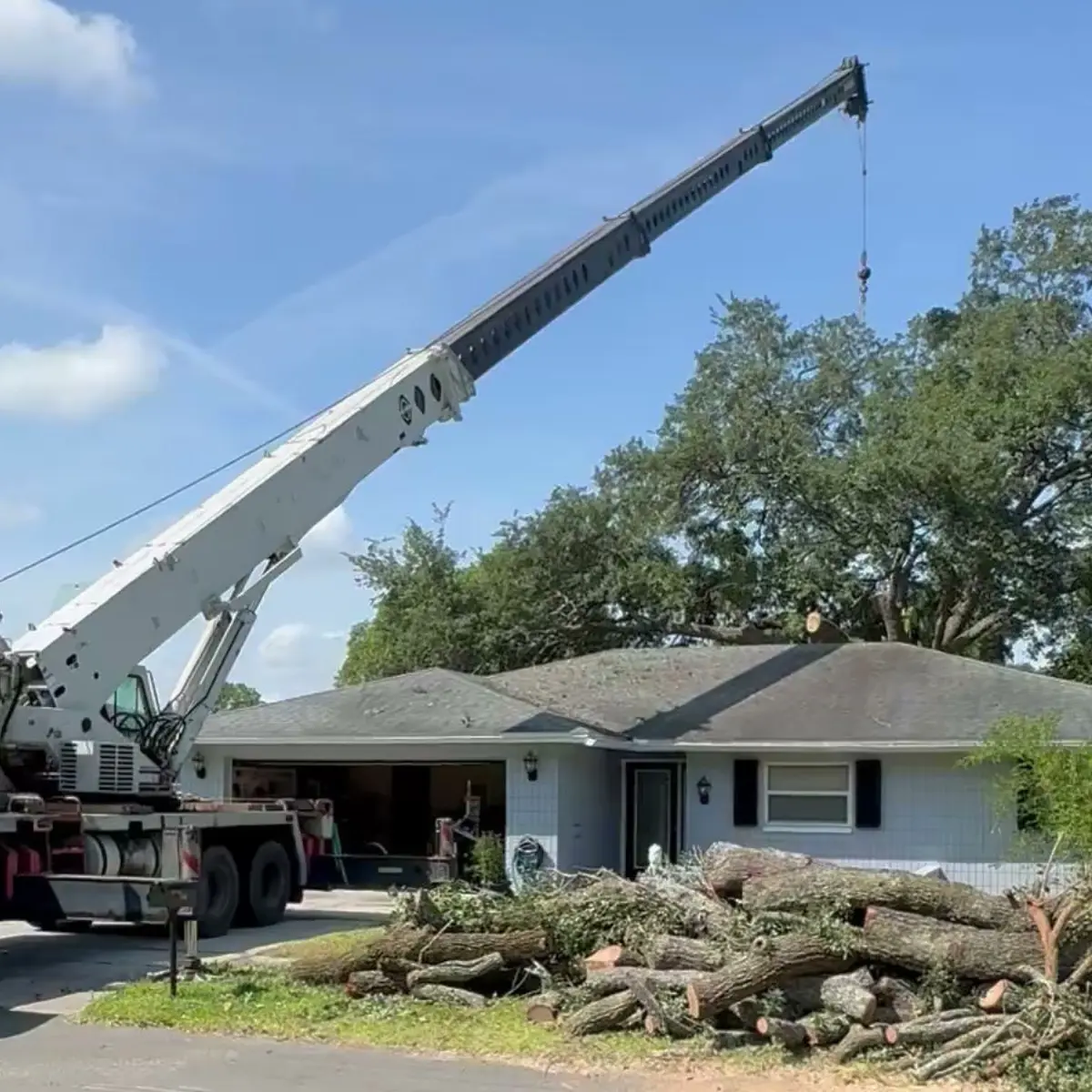
Grand Oaks Tree Service uses bucket trucks, grapple trucks, rigging systems, stump grinders, and crane-assisted removal setups for appropriate projects. The equipment selected depends on access and what is required to complete the approved work.
Our tree cutting services may be used to separate damaged sections or reduce a tree into manageable pieces. We do not recommend property owners attempt to climb, rig, or cut unstable trees.
Removing Debris and Checking the Area
Cleanup is completed according to the approved job scope. Our crew removes the designated branches, logs, and other tree debris and then checks the work area.
Emergency removal may leave a stump after the immediate tree hazard has been addressed. Stump grinding is a separate service and should be included in the estimate if you want the remaining stump reduced below ground level.
What Affects the Cost of Emergency Tree Removal?
The cost of emergency tree removal depends on the tree, the damage, the property layout, and the equipment required. An on-site assessment is necessary because general price ranges may not reflect the actual work.
Several factors can affect the estimate:
- Tree height and trunk diameter
- Whether the tree is standing, leaning, or fallen
- The extent of trunk, root, and branch damage
- Proximity to buildings, vehicles, and fences
- Equipment and crew access
- The need for controlled rigging or lifting
- The amount of debris to be removed
- Whether stump grinding is requested
- Whether work must wait for a utility provider or another authority
A tree lying in an open yard may be easier to access than one resting on a roof. A broken limb already on the ground also requires a different approach from a heavy branch suspended over a structure.
Our team evaluates these conditions before providing a clear scope and estimate. We do not promise a standard price without first understanding the project.
What to Expect When You Contact Our Team
When you contact Grand Oaks Tree Service, we ask for basic information about the tree and what it is affecting. This helps us understand whether the situation involves a fallen tree, unstable branch, blocked entrance, damaged structure, or another urgent concern.
We do not promise a specific arrival time before reviewing current conditions, location, accessibility, weather, and crew availability. Active storms and widespread damage can affect safe scheduling.
Once our team evaluates the property, we explain the recommended work and the equipment that may be needed. You receive an estimate before the approved removal begins.
Our general process includes:
- Reviewing the immediate tree concern
- Inspecting the damaged tree and surrounding property
- Developing a removal or corrective-work plan
- Providing a clear estimate
- Completing the approved service
- Removing the included debris
- Checking the work area
If the tree can reasonably remain, we may discuss tree trimming or pruning instead of complete removal.
Insurance Documentation After Tree Damage
Grand Oaks Tree Service can assist with certain documentation that may be useful when tree damage involves a home, fence, driveway, or another structure. Available assistance can include photographs of visible damage, job-scope information, and written estimates for insurance submission.
For qualifying storm-damage cases, direct insurance billing may be available. Eligibility depends on the situation, insurer, policy, and other claim requirements.
We cannot guarantee that an insurance company will cover tree removal or approve a claim. Coverage decisions are made by the insurer according to the policy and circumstances. Contact your insurance provider promptly to ask what documentation it requires and whether work may begin before an adjuster reviews the damage.
Keep copies of photographs, estimates, invoices, and communication related to the incident. Only enter the damaged area when it is safe to do so.
Why Professional Removal Matters for Damaged Trees
Storm-damaged trees can contain heavy sections under tension, compression, or uneven support. Cutting one section may cause another part of the tree to shift, drop, roll, or separate.
Professional planning is particularly important when a tree is leaning, uprooted, split, or resting on a structure. Our team considers how the tree is supported before determining the order in which sections should be handled.
Grand Oaks Tree Service is locally owned and operated, licensed and insured, and has more than 35 years of combined experience. We use specialized equipment to complete controlled tree work and protect the surrounding property.
You can learn more about our services and approach on the Grand Oaks Tree Service website.
Frequently Asked Questions About Emergency Tree Removal in Brandon
Do I need permission to remove an emergency tree in Brandon?
Requirements depend on the property, tree, project, and jurisdiction responsible for the location. Emergency conditions do not automatically remove every permitting or approval requirement. Contact the appropriate local authority and your property association, if applicable, to confirm what is required.
Can a storm-damaged tree be saved?
Some storm-damaged trees can remain after appropriate pruning or corrective work. Trees with major root failure, severe trunk splitting, or extensive structural loss may require removal. A professional evaluation is needed to determine which option fits the tree’s condition.
How quickly can emergency tree removal begin?
Scheduling depends on current weather, location, crew availability, equipment needs, utility hazards, and the extent of the damage. We do not guarantee an arrival time before reviewing the situation. Call (813) 670-9930 and provide as much safe, visible information as possible.
How often should potentially hazardous trees be evaluated?
There is no single schedule for every tree. Age, species, condition, prior damage, location, and proximity to structures can affect how often evaluation is appropriate. Request an assessment after severe weather or whenever you notice new leaning, cracks, root movement, hanging limbs, or other significant changes.
What should I do if a fallen tree is touching a power line?
Stay away from the tree, line, and anything they may be touching. Contact the utility provider and emergency authorities when appropriate. Do not attempt to move or cut the tree until the electrical hazard has been addressed.
Is stump grinding included with emergency tree removal?
Stump grinding is a separate service unless it is specifically included in your approved estimate. Emergency work may initially focus on removing the unstable tree and restoring access. Tell our team if you also want the stump addressed.
Does insurance always pay for emergency tree removal?
No. Insurance coverage depends on the policy, cause of damage, affected property, and the insurer’s decision. Grand Oaks Tree Service may assist with photographs, job-scope details, and written estimates, but we cannot guarantee claim approval or payment.
Request Emergency Tree Removal in Brandon, FL
If a fallen, leaning, split, or storm-damaged tree is affecting your Brandon property, keep everyone away from the unstable area and contact Grand Oaks Tree Service. Call (813) 670-9930 or request emergency tree service online so our team can review the situation, explain the next step, and provide an estimate.