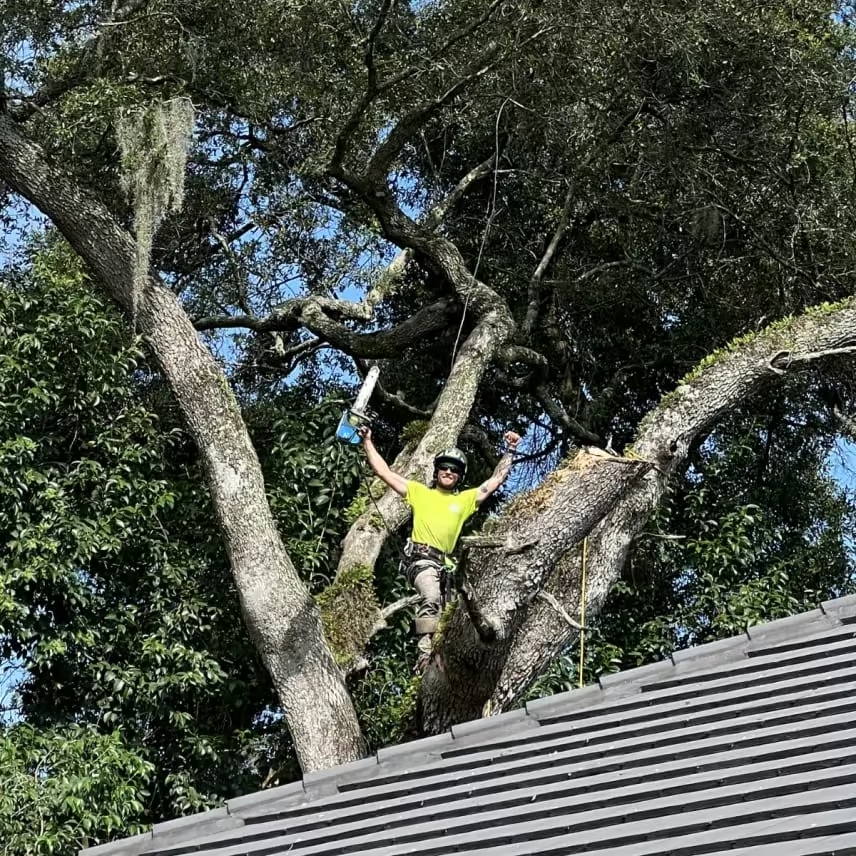
Removal is usually the responsible choice when a tree is dead, its main roots or trunk are failing, decay has significantly weakened structural wood, storm damage cannot be corrected, or the tree presents a risk that reasonable care cannot reduce. Limited problems may lead to a different recommendation. Isolated dead branches, manageable clearance issues, or minor storm damage may be addressed through pruning and monitoring.
Grand Oaks Tree Service provides save-or-remove assessments in Wesley Chapel and throughout Pasco County. We examine the whole tree, its location, and what it could strike before recommending preservation work or removal. If a tree is actively splitting, uprooting, falling, or blocking access, we also provide 24/7 emergency service.
Save-or-Remove Tree Assessments in Wesley Chapel
Our assessment determines whether a tree can remain with reasonable care or whether removal is safer. We do not decide from one symptom or photograph. Our team examines visible roots, the trunk, major unions, canopy, prior damage, available space, and nearby targets. You receive an explanation and a clear estimate for recommended work.
Conditions That Usually Favor Tree Removal
Removal becomes more likely when the tree’s support system has failed or corrective work cannot reduce the risk reasonably. The International Society of Arboriculture’s tree-risk guidance identifies pruning, monitoring, moving certain targets, and removal as possible responses.
Conditions that may support a removal recommendation include:
- A dead tree with no realistic recovery path
- Broken major roots or active movement of the root plate
- A cracked, split, or severely compromised main trunk
- Extensive decay in wood that carries major loads
- Storm damage that leaves the remaining structure unstable
- A serious conflict with a building or construction that cannot be corrected without destabilizing the tree
- A tree likely to strike a home, utility line, or occupied area
A cavity, mushroom, lean, or dead branch does not settle the decision. Our guide to general tree-removal warning signs provides a separate visual checklist.
Conditions That May Support Tree Preservation
Preservation may remain reasonable when damage is limited and the roots, trunk, and canopy retain usable structure.
Examples include:
- One or several dead or broken branches
- Limited canopy damage after a storm
- A stable, longstanding lean without root-zone movement
- A health problem that has not destroyed structural wood
- Clearance issues that can be corrected through selective pruning
- A tree in an open area with limited consequences from failure
Options may include professional tree pruning, selected tree trimming, or monitoring. None guarantees that a tree will never fail.
Preservation and Removal Findings
These qualified examples are not a substitute for an on-site evaluation.
| Assessment Finding | Preservation May Be Reasonable | Removal May Be Recommended |
| Canopy damage | Damage is limited to selected branches | Remaining canopy is unstable |
| Root condition | Roots appear stable | Major roots are broken or shifting |
| Trunk condition | Sound structure remains | A deep crack affects the main trunk |
| Decay | Limited and away from support areas | Extensive in load-bearing wood |
| Lean | Longstanding, with stable roots | Recent, with root movement |
| Location | Few targets are within reach | An occupied or valuable target is exposed |
| Storm damage | Selective pruning may address it | Remaining structure cannot be stabilized |
Tree Condition and Property Risk Work Together
Tree health and structure are not identical. A green canopy does not rule out weak roots, decay, or a split union. A declining tree in an open area may call for a different response than one beside a home or driveway.
During the assessment, we identify potential targets such as:
- Homes, garages, sheds, and pool enclosures
- Driveways, vehicles, sidewalks, and gates
- Fences and neighboring property
- Utility lines
- Patios, play areas, and gathering spaces
UF/IFAS considers remaining structure, roots, health, species, and site conditions in its damaged-tree assessment guidance.
Our Save-or-Remove Assessment Process
We focus on the condition and the service, if any, that fits the property.
- Discuss the concern: We ask what changed and when you noticed it.
- Inspect the structure: Our team checks visible roots, trunk, unions, and canopy.
- Review the location: We consider species, condition, space, and nearby targets.
- Identify options: We determine whether pruning or monitoring could help.
- Compare outcomes: We recommend monitoring, pruning, or removal.
- Explain the work: We provide a defined scope and clear estimate.
- Schedule service: We arrange approved work and included cleanup.
Pruning and Tree Care Before Removal
Professional pruning may help when the concern is confined to certain branches. We may recommend deadwood removal, broken-limb removal, clearance pruning, corrective pruning, or reduction of an overextended limb.
Pruning cannot repair failed roots, a split trunk, or extensive decay. We do not recommend topping or arbitrary canopy reduction. Limited storm damage may also call for monitoring.
Situations That Need Prompt or Emergency Removal
A scheduled assessment fits a stable condition. Keep clear and call our 24/7 emergency tree service for active root-plate movement, a sudden lean, a splitting trunk, a tree on a structure, blocked access, or hanging limbs over occupied areas.
Do not approach a tree touching a utility line. Contact the utility provider first. Tree work begins after safe access is confirmed.
Professional Tree Removal and Site Cleanup
When preservation is no longer reasonable, we plan controlled removal around roofs, fences, driveways, and landscaping. Access, tree condition, working space, and nearby targets shape the plan. Our professional tree-removal service explains methods, equipment, and pricing factors.
Our Wesley Chapel removal and HOA guide covers possible requirements. Confirm current rules for your property.
Stump Grinding After Removal
Stump grinding is a separate decision that may prepare the space for sod, landscaping, or another use.
Our stump-grinding service grinds the stump below the surface. Roots remain in the soil and decay over time. We review access and utility concerns first.
Local Tree Assessments Across Pasco County
We provide assessments in Wesley Chapel, Land O’ Lakes, Zephyrhills, Dade City, Lutz, Odessa, and Trinity. Mature trees may stand near roofs, fences, driveways, pool enclosures, and utility lines.
Our Pasco County service-area page lists additional locations.
Why Property Owners Call Grand Oaks Tree Service
We are locally owned and operated, licensed and insured, and based in Wesley Chapel. Grand Oaks Tree Service has more than 35 years of combined experience and uses professional equipment for pruning, controlled removal, cleanup, and emergency work. We provide clear estimates and no-surprise pricing.
Frequently Asked Questions
Does a hollow tree always need to be removed?
No. A cavity does not determine the recommendation by itself. We consider its location, the amount and condition of surrounding wood, the tree’s overall structure, nearby targets, and other visible defects. Extensive decay in load-bearing areas may favor removal, while a limited cavity may call for monitoring or other care.
Can a leaning tree still be saved?
Possibly. A stable lean that developed as the tree grew differs from a sudden lean with lifting soil or broken roots. Our team examines the root zone, trunk, canopy balance, direction of lean, and anything the tree could strike before recommending monitoring, pruning, or removal.
Can pruning correct every structural problem?
No. Pruning can remove selected dead, broken, poorly attached, or overextended branches. It cannot repair major root failure, close a split main trunk, or replace structural wood lost to extensive decay. We recommend pruning only when specific cuts can address the concern without creating excessive stress.
Should a dead tree be removed immediately?
A dead tree has no recovery path and will continue to deteriorate. How quickly removal should occur depends on its size, stability, location, and what it could strike. Keep people and vehicles away from questionable branches and arrange an assessment promptly. Active movement or falling sections require emergency attention.
How does our team decide whether removal is necessary?
We inspect the visible roots, trunk, major branch unions, canopy, prior damage, and growing space. We then consider the tree’s condition, species, size, location, and nearby targets. Removal is recommended when reasonable preservation options cannot reduce the concern to a manageable level for the property.
Is stump grinding included with tree removal?
Stump grinding is a separate service consideration rather than an automatic part of every removal. We can include it in the proposed scope when access, underground utilities, and your plans for the space allow. The estimate will state whether stump grinding and related cleanup are included.
Request a Save-or-Remove Tree Assessment
If you are unsure whether a tree should be preserved, pruned, monitored, or removed, call (813) 670-9930 or request a free save-or-remove assessment estimate. Our team will inspect the tree, explain the options, and provide a clear plan.